What is Elbow Instability?
Elbow instability is a condition in which the elbow joint occasionally slides out of alignment due to the unstable state of the joint.
What is Elbow Anatomy?
The elbow joint is made up of three bones: the humerus (upper arm bone), and the radius and ulna (the forearm bones). It consists of a hinge joint that permits flexion and extension of the arm, and a ball-and-socket joint that enables rotation of the wrist. There are three bony junctions in the elbow: the proximal radioulnar joint between the radius and ulna, the ulnohumeral joint between the ulna and humerus, and the radiohumeral joint between the humerus and the radius. The bones are held in position by a number of ligaments.
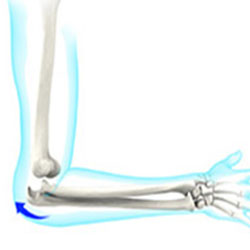
What Causes Elbow Instability?
Elbow instability usually occurs as the result of an intense elbow injury from a fall, or other trauma with or without elbow joint dislocation. Instability can also be associated with:
- Previous elbow surgery
- Elbow deformity
- Overuse injury
What are the Symptoms of Elbow Instability?
The various signs and symptoms of elbow instability include:
- Pain with arm movements such as bending or throwing
- Locking or catching of the elbow
- An unstable sensation
- A clicking sound
- Dislocation
How is Elbow Instability Diagnosed?
Your doctor will diagnose elbow instability based on your medical history and a physical examination. Once the preliminary diagnosis is complete, your doctor may use imaging techniques such as X-ray, MRI, or MRI arthrography to obtain a detailed view of the elbow and look for other injuries.
What are the Treatment Options for Elbow Instability?
Different treatment methods are used based on the severity of the condition.
Nonsurgical Treatment
Most cases of elbow instability can be managed by nonsurgical treatment including rest, activity modification, and physical therapy. Your doctor may perform an external reduction if the elbow is dislocated. A sling or brace may be used to keep the elbow immobile for a specific duration to facilitate healing. Simple motion exercises may be recommended to improve strength and movement.
Surgical Treatment
In some cases, surgical treatment may be necessary to restore elbow alignment and stability. This may involve repair or reconstruction of damaged ligaments and realignment of the bones in cases of fracture or dislocation. Once this is complete, an external fixator device may be used to support the joint and facilitate healing. In some cases, surgery may be required to repair damaged blood vessels and nerves. A defined recovery period and physical therapy are recommended following surgery.